Bruno Freschi
Bruno Freschi is one of North America’s most honoured architects. A Fellow of the Royal Architectural Institute of Canada and a member of the American Institute of Architects, he is among a few architects given the Order of Canada, the highest individual honour awarded by Canada. He was also the recipient of the 125th anniversary of Canadian Federation Commemorative Medal for significant contributions to architecture and education.
Graduating with Honours in Architecture from UBC, Bruno was awarded the Royal Architectural Institute of Canada Governor General’s Medal and the prestigious Pilkington Fellowship for the best architectural thesis in Canada. He continued his post-graduate studies at the Architectural Association in London, England, including extensive research in architecture and urbanism in Europe, the Middle East, India, and China. He has practiced in England, Italy, and Switzerland.
Bruno joined the firm of Erickson/Massey Architects as an Associate Partner and was a senior associate on the design teams for Simon Fraser University and the Provincial Law Courts/Vancouver Art Gallery Master Plan, among numerous other projects. He was also an Associate Professor in Architecture at UBC and later became head of a new Graduate Studies Program. In 1988, Bruno became Dean of the School of Architecture and Planning at the State University of New York at Buffalo. During his tenure, the school became a leading design and interdisciplinary architecture and planning school and doubled in size. During his deanship, Professor Freschi lead the public initiative in preservation and restoration at the Darwin Martin Complex, one of Frank Lloyd Wright’s pre-eminent designs in New York.
As a professor, Bruno was a leading proponent for the “integrated, transdisciplinary, and transcultural approach” to planning and sustainable, high-performance design. He utilized this approach in the master planning, renovation, and new construction of the two-campus Kyonggi University in South Korea, an institution of 20,000 students designed as Asia’s first “green” and global university. He would became a visiting Distinguished Professor at Kyoggi University.
Bruno Freschi, Architecture/ Planning/ Research was founded in Vancouver in 1975. His firm won numerous design awards for residential, cultural, and commercial projects. He was the Chief Architect and Master Planner for the 1986 World Exposition in Vancouver, architect of the EXPO Centre (now Science World), and the Vancouver Ismaili Jamatkhana for the Aga Khan. The firm was also responsible for visionary master plans for waterfront cities in Canada and the United States. The Urban Vision and Waterfront Master Plan was the catalyst in reviving Tacoma, Washington’s urban housing, cultural, and university precincts. Furthermore, Bruno lead teams responsible for master planning of urban school districts, as well as, designing primary, middle, and high schools in New York State.
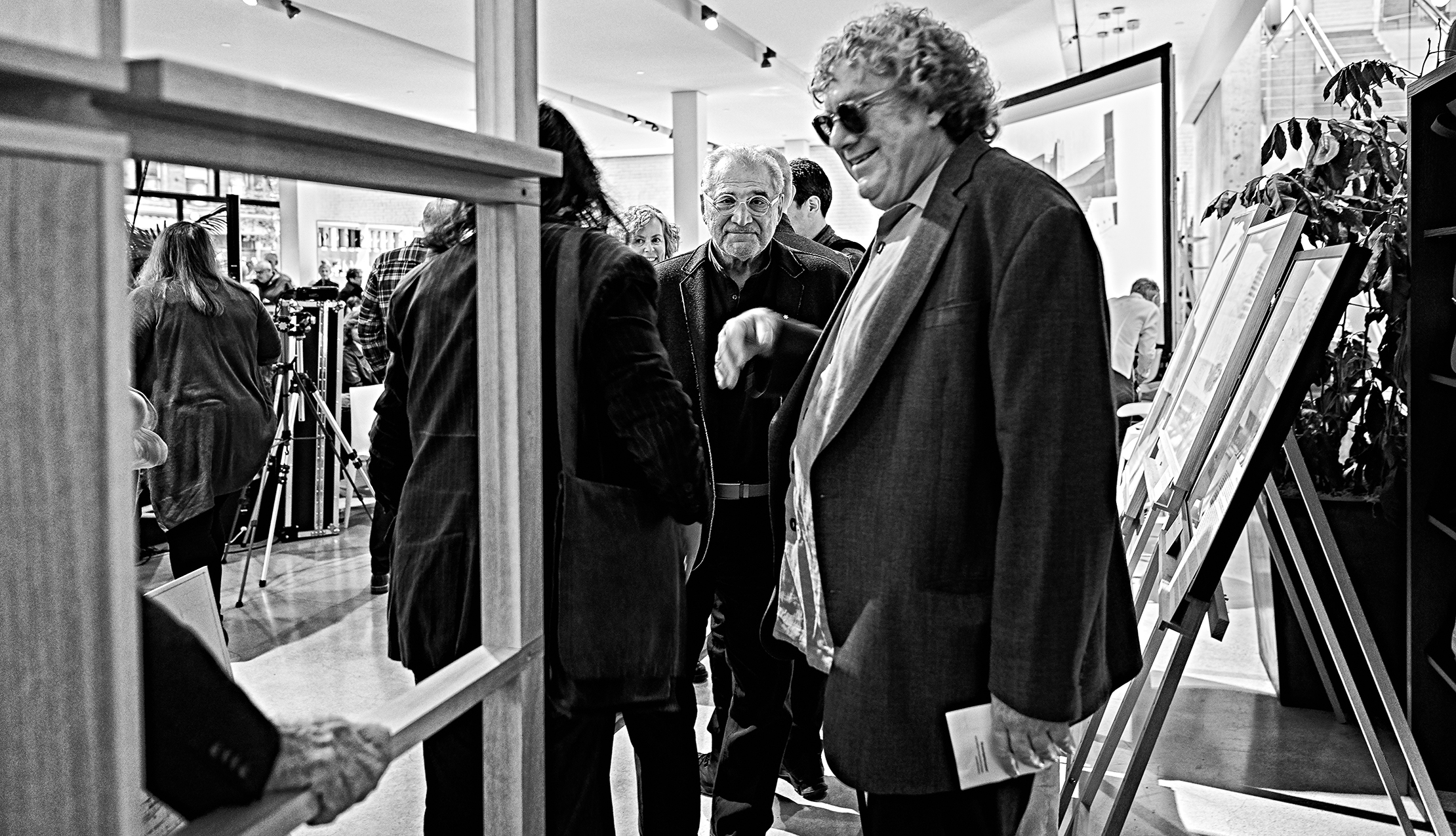
Photo by Illijc Albanese.
In 2017, for the League’s “Masters of West Coast Modernism” series, we asked Bruno to select mementos of personal and professional significance. These are the original drawings he created in response.
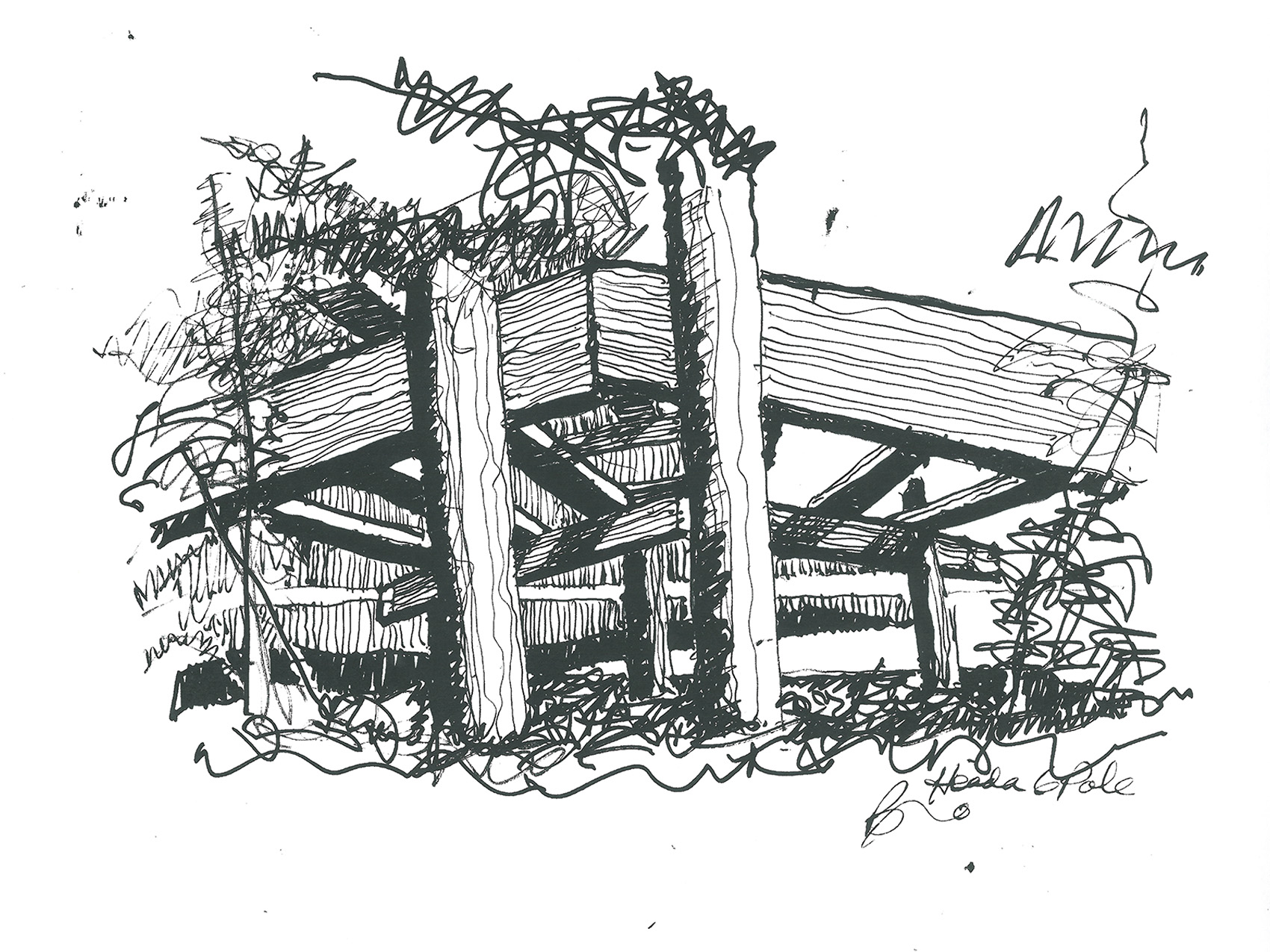
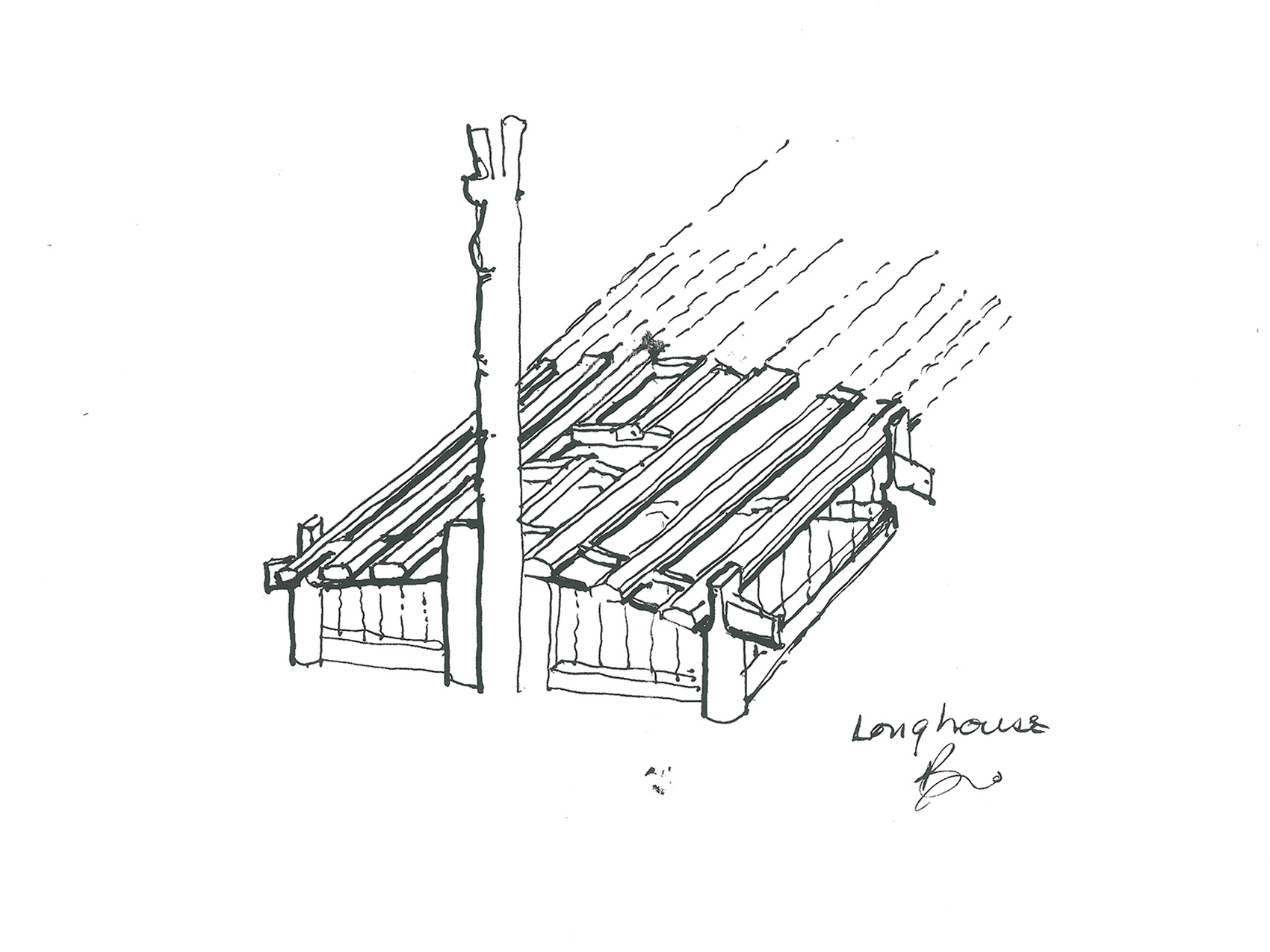
Indigenous Architecture of the West Coast
Bruno Freschi, Indigenous Architecture of the First Nations of the West Coast, c. 2018
Ink on Paper. Two Drawings.
Architecture of the indigenous First Nations on the west coast of B.C. is a major influence on my architectural work. I have toured and studied the indigenous sites with Bill Reid and in Haida Gwaii (Q.C.I.). I was captivated and overwhelmed by the presence and power of these structures, even in their ruins as they are slowly disappearing into the rain forest.
The Longhouse and the Polehouse, retain their majestic assertive presence, and are iconic symbols of place. These structures are massive heavy timber post and beam combined with relatively light “curtain walls” of moveable flat boards. This is a very modern, yet organic building system. The forms are iconic, absolute, ordered, legible and majestic in their classical crescent cluster formation fronting the sea, asserting their presence to the ubiquitous enveloping rain forest. As villages they form a crescent waterfront, a unified façade decorated in aboriginal symbolic carved and painted iconographics, framed by majestic, very tall totem poles emerging from the structures.
The architecture employs the abundance of timber, emblematic of the forgiving luxury of wood. Longhouse and Polehouse concepts exploit the scale and strength of large timber to structure long spans creating large spaces for multifamily communal living. This architecture is both extraordinary and very inspiring in form, scale and inherent logic of universal post and beam structure. There is a remarkable clarity of integration of structure, curtain wall and function.
The architecture is very powerful yet respectful of setting, it does indeed “touch the earth lightly.” Indigenous west coast architecture may be a precursor to our West Coast Modern idiom.
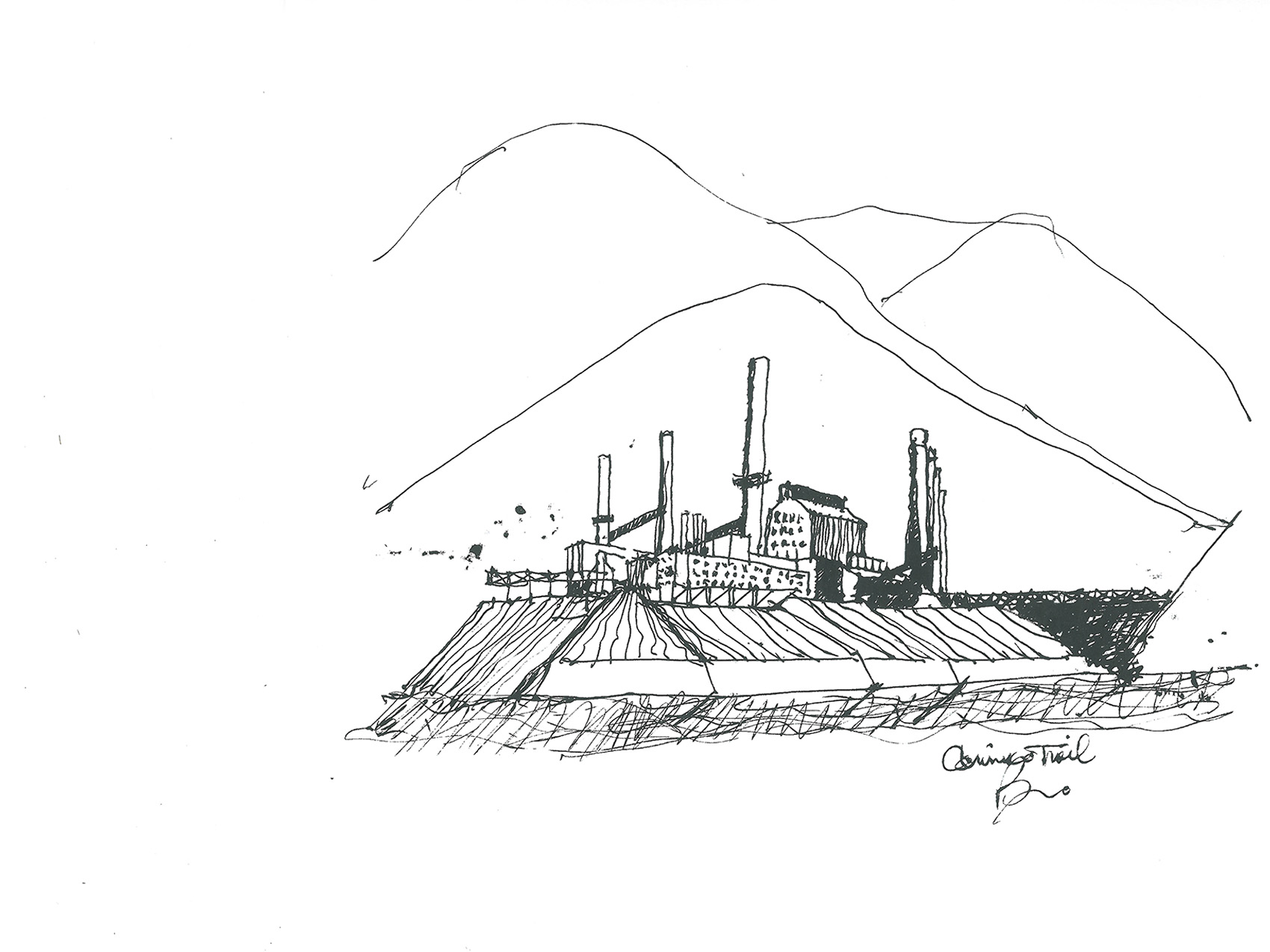
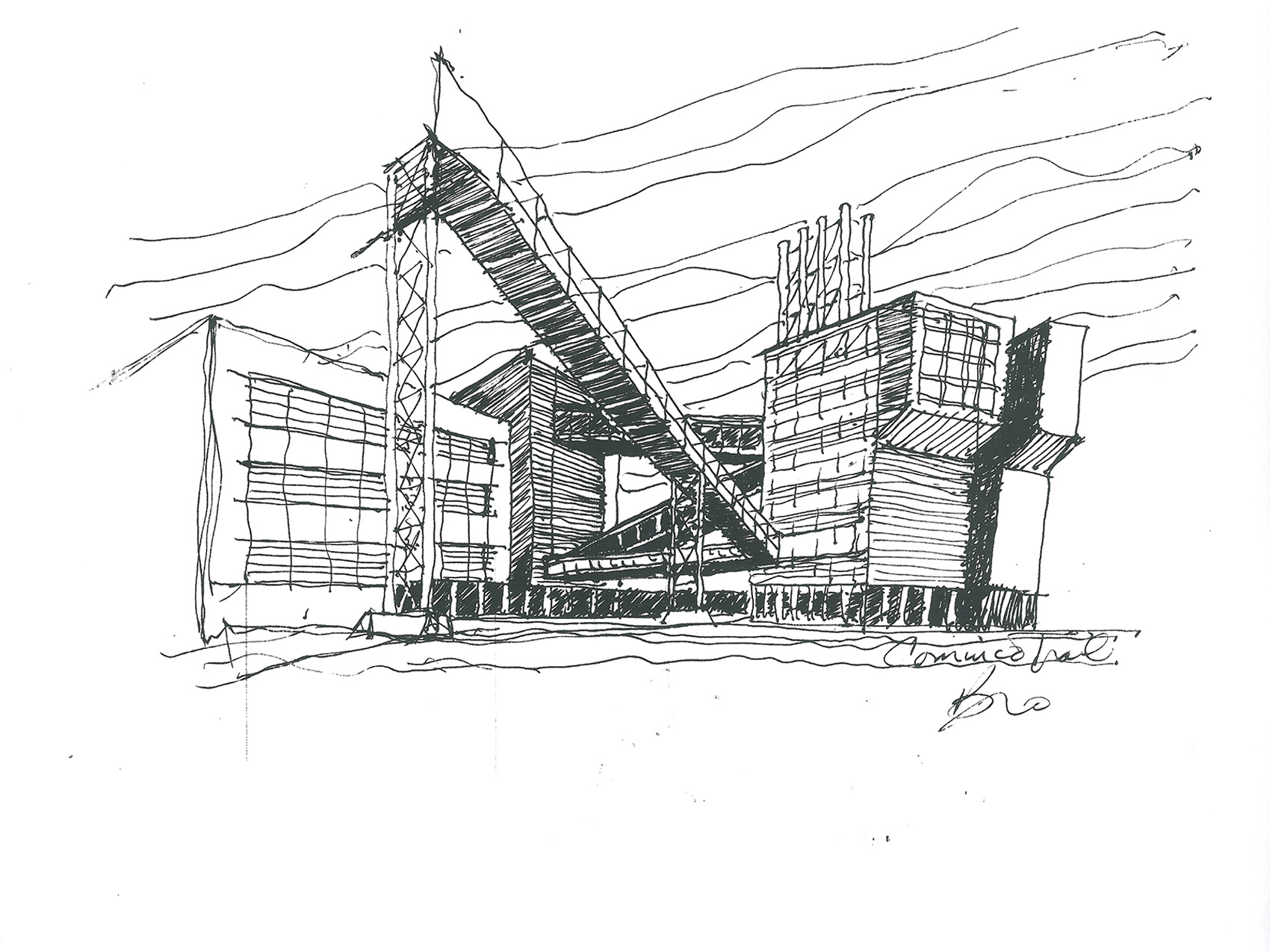
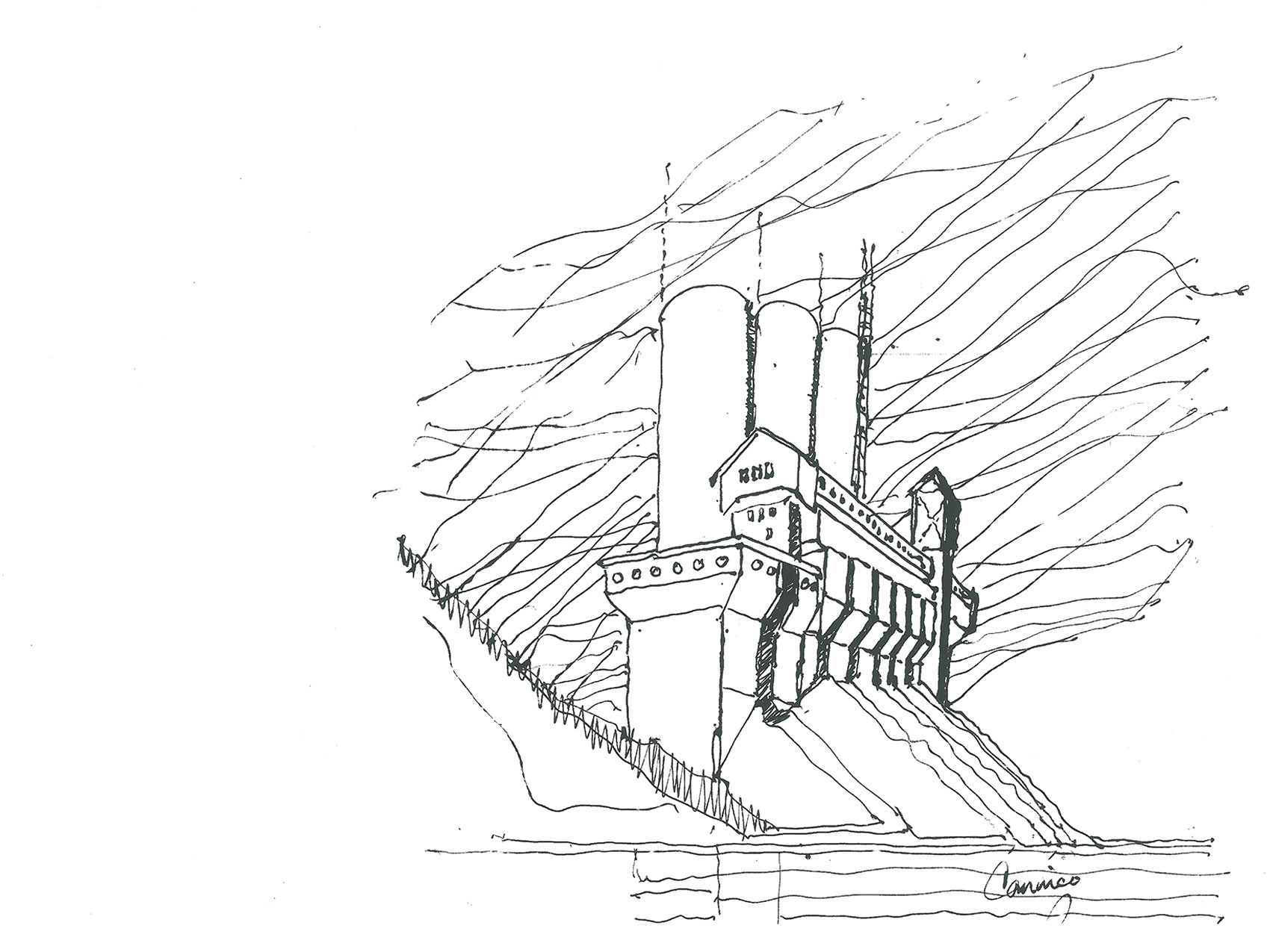
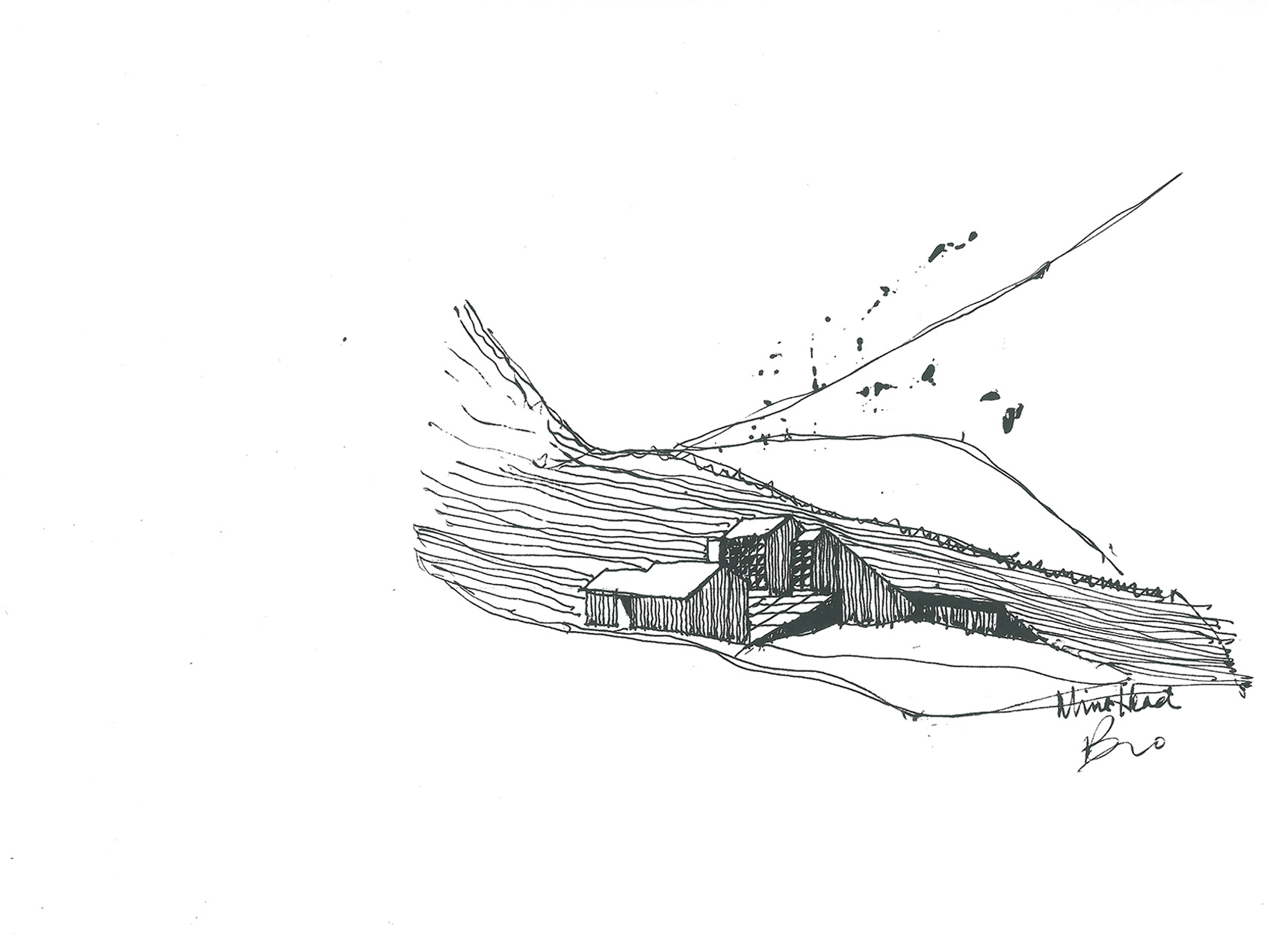
Early Industrial Architecture of BC
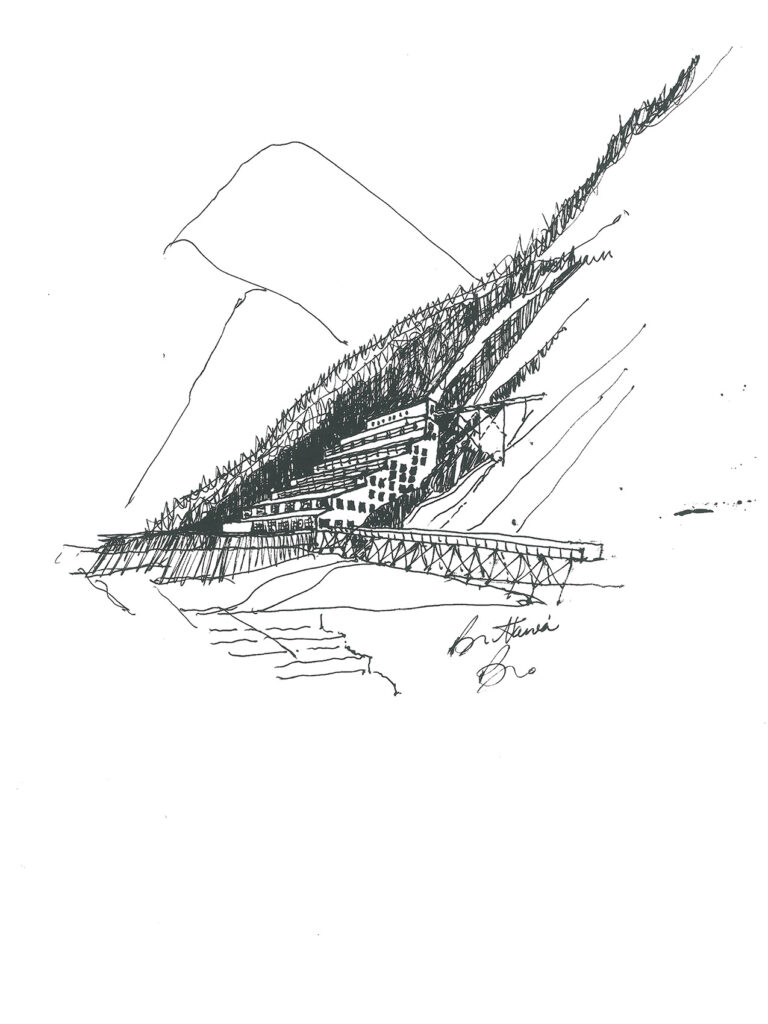
Bruno Freschi, Early Industrial Architecture of British Columbia, c. 2018
Ink on Paper. Five Drawings.
Industrial architecture has been a universal source of inspiration throughout modernism and even earlier. I too was captivated by the expression, assertiveness and formalism in the early industrial architecture of the resource industries in early BC.
Industrial buildings are usually in isolated sites, designed on a pure functionalist, rationalist programs. These buildings and complexes resulted in extraordinary forms and a synthesis of structures on sites and topography. As examples, I must mention the mine concentrator buildings of Britannia and Hedley, BC. Mining head houses, concentrators, smelting furnaces, and rail tressels are generic containers of extraordinary forms. Their formal qualities give powerful symbolic expression beyond their purposes.
Industrial architecture employed traditional and innovative heavy timber, post and beam. It was usually the innovator or brutalist raw concrete, steel and glass resulting in the “cathedrals” of modernity. Industrial processes necessitated a vocabulary of shapes of containers resulting in beautiful and poetic syntheses of form.
Daylight is precious. Industrial buildings exploited and harnessed light almost poetically. Timber, steel, concrete and glass are combined in symphonies of form to give light to space.
Industrial architecture, like some of the industries it housed, probably destroyed their sites, however, there remains a quotidian magic in the pure forms and assertive presence of this heritage. It is architecturally modern and inspiring in West Coast Modern design.
- Bruno Freschi (August 2018). Interview with Kiriko Watanabe, West Coast Modern League.
- Bruno Freschi Personal Archives.